
For the longest time, I believed there was only one way to write fantasy.
It had to be poetic.
Every scene had to be layered with description. Every moment had to paint a picture so detailed that the reader could walk through it exactly as I saw it. If a sentence was simple, I worried it wasn’t good enough. If a chapter wasn’t long enough, I worried it lacked depth.
I convinced myself that simplicity was a shortcut.
As I’ve been revising The Stone of Fate, the first book in my Gray Storm Series, I’ve realized something surprising.
Many of my favorite fantasy novels are filled with beautiful worldbuilding and rich descriptions. The worlds are incredible. The stories are unforgettable.
But if I’m being truthful as a reader, I don’t read every word.
I skim.
I read enough to understand the setting, then my imagination takes over. Sometimes I move past entire paragraphs of description to get back to the characters, the conflict, and the story itself.
For years, I held my own writing to a standard I wasn’t even following as a reader.
That realization changed something for me.
The story doesn’t become less meaningful because the prose is simpler.
The emotions don’t become weaker because a sentence is shorter.
Sometimes the most beautiful line in a chapter is the one that says exactly what it needs to say and nothing more.
So while revising Gray Storm, I’m giving myself permission to let go of the idea that every sentence must prove itself.
I’m tightening scenes.
Removing words that aren’t serving the story.
Trusting readers to meet me halfway.
Most importantly, I’m learning that writing isn’t about following a formula. It’s about finding the version of the story that feels true.
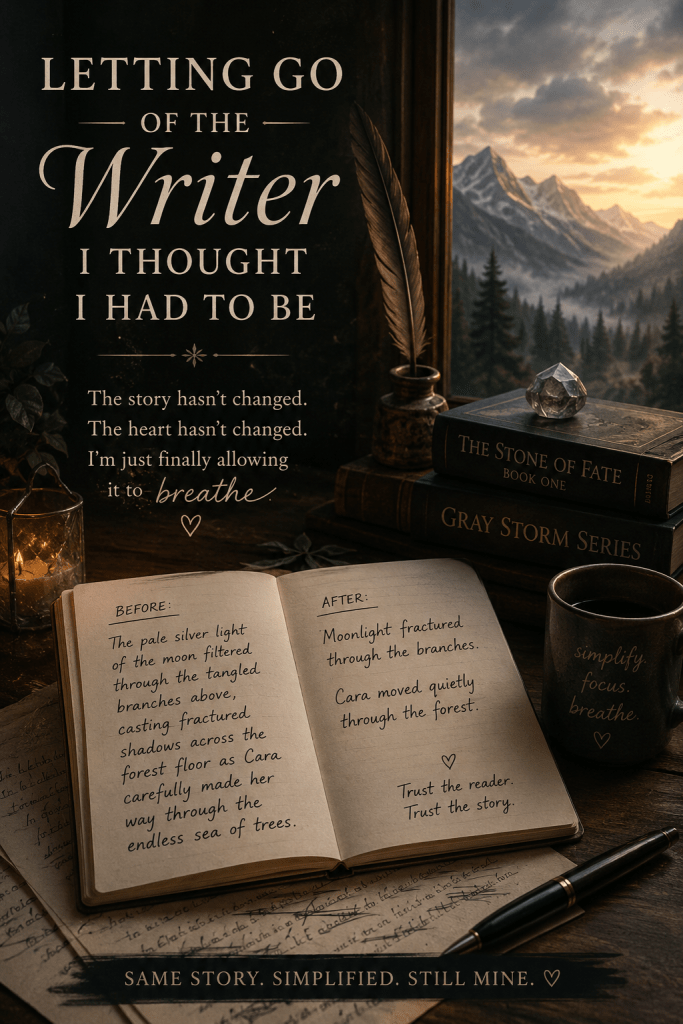
The story hasn’t changed.
The heart hasn’t changed.
I’m just finally allowing it to breathe.
Here is one small example from my revisions:
Before:
“The pale silver light of the moon filtered through the tangled branches above, casting fractured shadows across the forest floor as Cara carefully made her way through the endless sea of trees.”
After:
“Moonlight fractured through the branches. Cara moved quietly through the forest.”
The first version paints every detail.
The second trusts the reader to paint the rest.
Neither is wrong.
But lately, I’ve found myself drawn to the version that gets out of the way and lets the story speak.
Sometimes growth as a writer isn’t learning what to add.
Sometimes it’s learning what to let go.


Leave a Reply