
Behind the Mirror
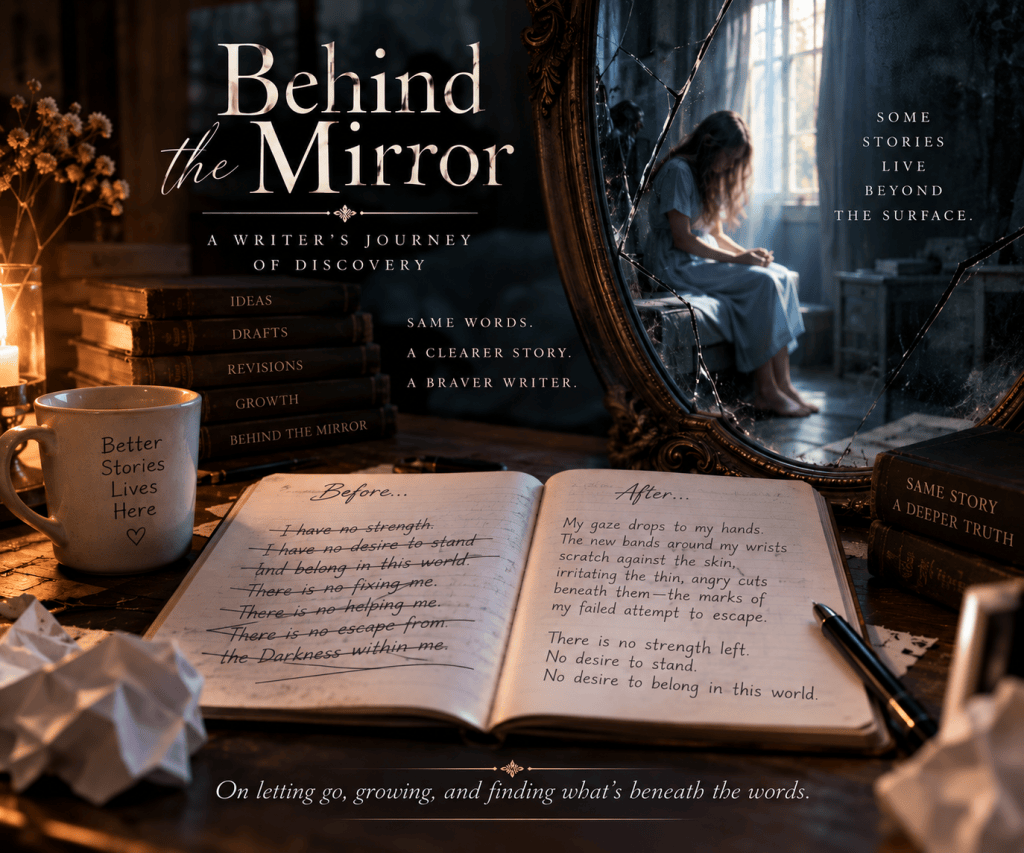
There comes a point in every creative journey when you have to step back and look at your work through someone else’s eyes.
That hasn’t always been easy for me.
For a long time, I protected what I wrote. I liked my words. I liked the way I told my stories. They came from my imagination, my experiences, and the worlds I had spent so much time building.
So when someone suggested changing something, even something small, it stung.
What I heard was:
“You need to rewrite it.”
And honestly, my first reaction was to resist.
Why should I change it?
This is how I wrote it.
This is how I saw the scene.
But time has a way of giving us some distance from our own work.
I’ve begun to understand that constructive criticism isn’t necessarily asking me to throw away what I’ve created. Sometimes it is simply asking me to look at it from another angle.
That realization has become an important part of my growth as a writer.
Learning to Let the Reader Discover the Emotion
While working on Behind the Mirror, I’ve been looking more closely at how I tell each character’s story.
Dorothy carries a deep sadness. When I first wrote her chapter, I wanted the reader to understand immediately what she was feeling.
I explained her sadness.
I explained her hopelessness.
I explained how much she hated herself.
But as I worked through the chapter again, I began to see something I hadn’t understood before.
The reader doesn’t always need to be told what a character feels.
Sometimes, the writing becomes stronger when the emotion is allowed to exist between the words.
For example, here is a small section from the original version:
I look down at my hands. The new bands scratch at my skin, irritating the thin long cuts on my wrist, the signs of my failed attempt to escape.
I have no strength. I have no desire to stand and belong in this world.
There is no fixing me. There is no helping me. There is no escape from the Darkness within me.
There is nothing wrong with telling the reader what Dorothy feels. But I began asking myself:
What if I let the reader discover it instead?
So I reworked the passage:
My gaze drops to my hands. The new bands around my wrists scratch against the skin, irritating the thin, angry cuts beneath them—the marks of my failed attempt to escape.
There is no strength left. No desire to stand. No desire to belong in this world.
A soft knock sounds at the door.
I don’t care who it is.
No company. No pity. No more lies spilling from the mouths of people pretending to understand.
The story hasn’t changed.
Dorothy hasn’t changed.
But the way her sadness reaches the reader has.
Instead of explaining everything, I can give the reader the cold tile beneath her feet, the bands against her skin, the untouched tray, the silence, the sunlight she refuses to acknowledge.
Those details allow the reader to step into Dorothy’s world.
And that is something I’m learning to appreciate.
Editing Doesn’t Mean Erasing
For a long time, I thought editing meant changing what I had written.
Now I’m beginning to understand that sometimes editing means uncovering what is already there.
The story doesn’t necessarily need to be rewritten.
Sometimes a sentence needs to be rephrased.
Sometimes a paragraph needs to breathe.
Sometimes something needs to be removed.
And sometimes the most important change is learning when not to explain.
That last one has probably been the hardest lesson for me.
As a writer, I know what my characters are feeling. I know their histories. I know what happened before the scene began and what will happen afterward.
The reader doesn’t.
And that’s okay.
In fact, that’s part of the magic.
The reader should have room to discover.
When a reader discovers an emotion rather than simply being told about it, they become more involved with the character.
They aren’t just reading that Dorothy is lonely.
They are sitting beside her in that room.
They aren’t just being told that she is hurting.
They are noticing the way she stares at her hands.
They are hearing the nurse leave.
They are watching the sunlight fall across the room while Dorothy remains in the darkness.
That is the kind of connection I want to create.
Growing Without Losing My Voice
This has been a growing moment for me—not because I’ve suddenly learned everything about writing, but because I’ve finally become more willing to listen.
There was a time when criticism felt like rejection.
Now, I’m beginning to see it differently.
Someone pointing out a weakness in my writing isn’t necessarily telling me that the story is bad.
Sometimes they’re helping me see something I was too close to notice.
That doesn’t mean I will accept every suggestion. My stories still belong to me. My voice still matters.
But I don’t want pride to become a wall between me and the story I’m trying to tell.
Behind the Mirror is about looking beyond what appears on the surface. It is allowing me to discover my own personal growth. As a creator, I must learn to look past my ego and set my pride aside.
that applies to the writing, too.
I’m learning to look beyond the words I originally wrote and ask:
Is there something more underneath them?
Maybe that’s what growth really looks like.
Not becoming a completely different writer.
Just becoming more willing to see what was there all along.


Leave a Reply