
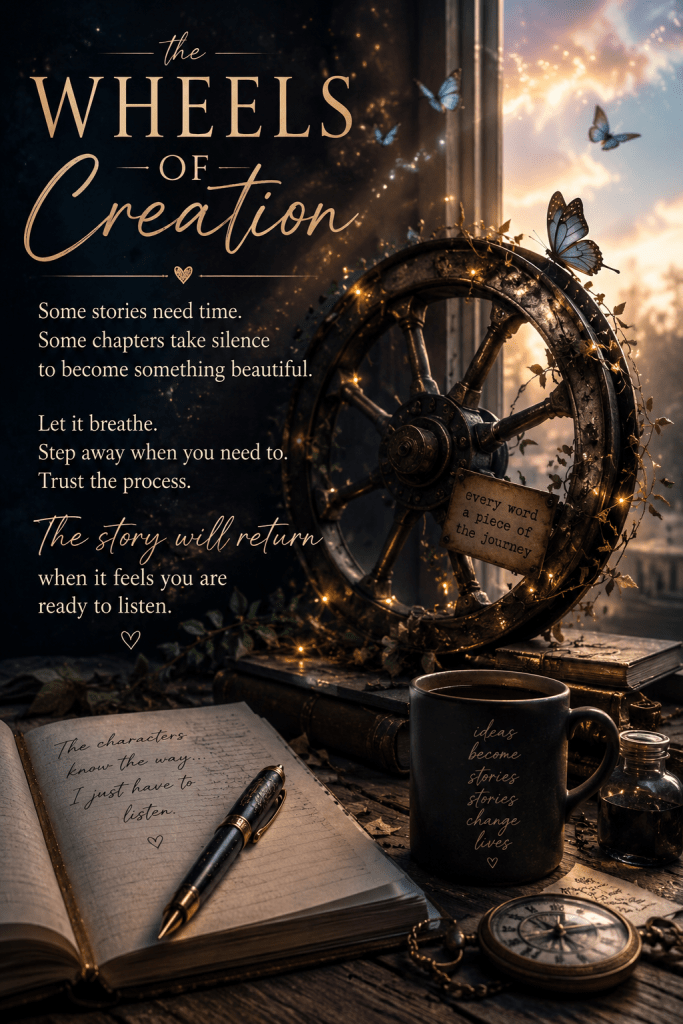
There is something magical about feeling the wheels of creation begin to turn once more after a project has remained silent for far too long.
As writers, we often hear advice about consistency, discipline, and daily word counts. While those things certainly have their place, I have learned that some stories refuse to be rushed. They reveal themselves only when they are ready, and sometimes that means allowing them the space to breathe.
Over the years, I have spoken often about trusting the process and letting a story unfold naturally. Three of my most personal projects—Far from Oz, Falling from Neverland, and Free from the Looking Glass—have taught me that lesson more than any others.
What began as simple ideas eventually became stories filled with emotion, healing, loss, hope, and self-discovery. As I changed, the stories changed with me.
Far from Oz: Learning to Walk in the Real
When I first conceived Far from Oz, I thought I was writing about a journey. Over time, I realized I was writing about awakening.
The story became less about the destination and more about finding the courage to face reality after living within dreams, expectations, and comforting illusions.
One of my favorite passages captures that moment perfectly:
“I feel my eyes flutter as the dream of white clouds and my mother’s voice fades away. I am aware of the heavy blankets that cover me. I take a deep breath and sigh as I know I am waking.
I can no longer sleep.
I can no longer dream.
I have to walk in the Real.
I have to know what happened to me.
I need to understand what my mother saved me from.”
That simple idea of waking up eventually became something much larger—a story about truth, courage, and discovering who we are beyond the stories we’ve been told.
Falling from Neverland: The Weight of Good Intentions
Falling from Neverland surprised me more than any project I’ve ever written.
What began as a story about loss evolved into an examination of guilt, responsibility, and the difficult truth that even our best intentions can sometimes lead to unintended consequences.
One passage reflects that realization:
“Haunted by the silhouettes of the lost, each step forward is burdened with the realization of the limitations and the consequences of my choices. I recall the ambition of my youth, the noble intent to transcend the failings of my father and to forge a new path in the realm of medicine, one that offered hope and healing to those marginalized by society.
Yet, the reality of those efforts, tainted by the very darkness I sought to eradicate, unfolds around me, a grim testament to the complexity of human endeavor.”
As the story grew, so did its themes. It became a reflection on the burdens we carry and the lessons we learn when life refuses to fit neatly into the ideals we once held.
Free from the Looking Glass: Remembering What Was Lost
Of the three stories, Free from the Looking Glass has challenged me the most.
For a very long time, the manuscript remained frozen at 15,353 words. Every attempt to continue felt forced. The story wasn’t ready, and perhaps neither was I.
Life became busy. Priorities shifted. The manuscript sat quietly, waiting.
Then, over the last several days, something changed.
The characters began speaking again.
Scenes unfolded naturally. Questions that had lingered unanswered for months suddenly found their place.
The story came alive.
One of the newest passages captures the emotional heart of the journey:
“I looked back toward Quinn.
Toward the boy I had forgotten.
The boy who had never forgotten me.
‘Why couldn’t I remember?’
His smile faded slightly.
When he finally answered, his voice was little more than a whisper.
‘Because some memories hurt too much to carry.’”
That single exchange reminded me why I fell in love with storytelling in the first place. Sometimes the most powerful moments are not found in grand adventures or dramatic revelations. Sometimes they are found in quiet truths that reach into places we did not realize still needed healing.
Trusting the Silence
One of the hardest lessons I have learned as a writer is that silence is not failure.
A manuscript sitting untouched for weeks, months, or even years does not mean it is abandoned. Sometimes the story is still growing beneath the surface. Sometimes life must teach us something before we can write the next chapter.
I know many writers struggle with those stagnant moments. I know what it feels like to stare at a manuscript and wonder if the spark has disappeared forever.
If you find yourself there now, give yourself permission to step away.
Allow the story to breathe.
Trust that the characters have not left you.
When the time is right, they will begin speaking again.
And when they do, listen.
The wheels of creation will turn once more.


Leave a Reply