
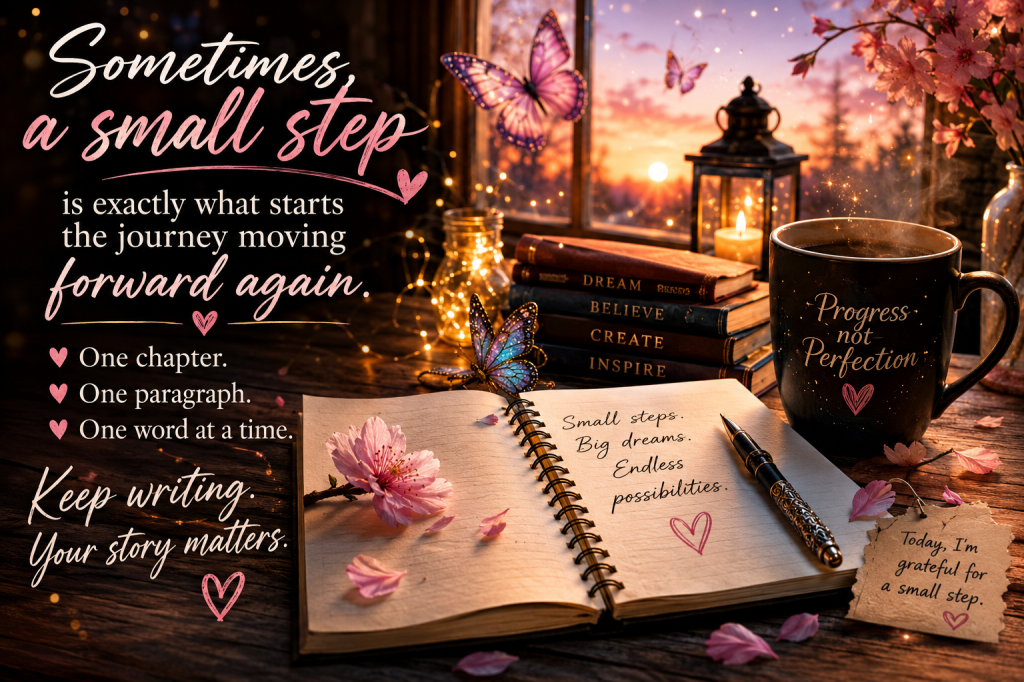
Today was a good day.
It may not seem like much to anyone else, but today I finally wrote the chapter that has been quietly waiting for me for months. The words that had refused to come suddenly found their way onto the page, and before I knew it, they led me into the next chapter and even the beginning of a few more.
For the first time in a long while, the doors to Free from the Looking Glass opened again.
As writers, artists, and creators, we often measure success by the finish line—a completed manuscript, a published book, or a new release. We forget that every story is built one paragraph, one page, and one chapter at a time.
Creative blocks can be discouraging. When you’re passionate about a project, silence can feel like failure. I tried everything to keep moving forward. I stayed positive, drafted a new project, revisited older stories for editing, and continued creating in other ways. Yet the chapter I wanted most remained just out of reach.
Today, it finally arrived.
I don’t know what changed. Maybe I needed more time. Maybe my characters weren’t ready to speak until now. Whatever the reason, I’m grateful that I listened instead of forcing the story.
Every story I write carries high expectations. I want the words to feel genuine. I want my characters to draw readers in and make them laugh, cry, hope, and overcome obstacles alongside them. To me, their journeys are real, and they deserve the time it takes to tell them well.
I’ve spent nearly sixteen years working on the Graystorm series. The first draft of the first book is complete, and much of the second is written. Even now, I continue refining every detail because I know the story can be stronger. I’m also grateful for the incredible tools available today that help writers polish their work with a fresh perspective.
I wrote Far from Oz back in 2012, and I’m still working toward completing the trilogy. My goal is to finish it this year, but I refuse to rush a story simply to reach the end. Some stories need time to breathe, and some chapters need patience before they’re willing to be written.
Today reminded me that progress doesn’t always look dramatic.
Sometimes progress is a single chapter.
Sometimes it’s two new ideas waiting in the wings.
Sometimes it’s simply sitting down, opening the document, and discovering that the creative spark never disappeared—it was just waiting for the right moment.
We live in a world that celebrates big milestones, but I think the small ones deserve just as much recognition. The page that finally gets written. The paragraph that finally feels right. The moment inspiration quietly returns after months of silence.
Those small steps become finished books, completed dreams, and goals we once thought impossible.
So today, I’m grateful for a small step.
And sometimes, a small step is exactly what starts the journey moving forward again
Here is another look inside book two.
Excerpt: Falling from Neverland
Dr. Hamish
In the depths of my darkest memories, I am overcome by tears once more, unable to stem their flow. Just as before, I bear witness to what others turn away from, yet I find myself paralyzed, unable to intervene. I fear that history may repeat itself. The human mind remains the most confounding puzzle, one I have yet to decipher despite years of study and experimentation. Despite the few who have entered Raven Hill seeking a cure and left with hope, doubt still lingers within me.
Feeling my mood souring, I realize I am in no state to offer counsel to anyone. Believing that Dorothy would benefit from a woman’s care, I summon Diana. Once assured that the child is in capable hands, I linger by Timothy’s bedside for a fleeting moment. “He may never wake, doctor.”
A young nurse approaches from the other side of the bed, her gaze fixed on Timothy. “All those seizures surely haven’t done him any favors.”
Her words are tinged with solemnity, seeking solace that I cannot provide. I have witnessed this scenario many times before, haunted by the nightmares of a harsh truth that refuses to relinquish its grip. The nurse speaks the undeniable truth—this young lad may never awaken, and even if by some miracle he does, he may remain lost to this world.
Unable to bear the weight of my current failure, I entrust Timothy to the nurse’s care and exit the infirmary. As I traverse the desolate halls, I anticipate another sleepless night. The flickering lights and distant thunder amplify the somber atmosphere that pervades this gloomy place. The vibrant colors that once adorned my walls have faded to monochrome, revealing the lingering specters of those lost years ago—a reminder of the failures that haunt me. Burdened by the weight of another day passed without righting the wrongs that have taken place, my heart feels heavy.
Returning to the one place that offers me some semblance of comfort, my office mirrors the colorless desolation of the hospital. Papers clutter my desk, while books lie scattered across various surfaces. Adjacent to the window stands an empty chair—a stark reminder of my inadequacy and lack of resolve. I sink into it, gazing out at a world I could not save.
The creaking of the floorboards beneath my feet adds to the sense of foreboding that envelops me. Shadows dance before me, welcoming me with open arms. I must resist the temptation to succumb to despair. I must cling to the belief in my work and my abilities. The haunting images will dissipate with the passing storm. I must close my eyes and allow the present to fade away, though I fear sleep may elude me. Yet, for the sake of my sanity, I must try. I sit by the window, hoping the storm will lull me into a deep, peaceful slumber.
Dorothy Rose
I used to believe that in dreams, I would find her. But something changed when I met Timothy. In dreams, I would be with my mother, and I would be happy again. That was all I believed. However, with Timothy, I was awake, and for a moment, I felt the happiness that I felt with my mother. He saw through my darkness. He pushed it away, and I could see the light again. I remembered the happy moments in the real world. I remembered the things that made me who I am, and in those brief moments, I was happy. But I am not normal. What made me who I am was not real. My mother’s last words still haunt me. “You are not mine.”
Even though she has told me time and time again that I was born for the darkness, I still struggle to understand her meaning. If I was bad, then why did Timothy not fear me? Why would he sacrifice himself for me? Why did he believe me to be good? I feel like I am caught in a cyclone, watching the strangeness of the world circle around me. For the first time in my life, I have to admit I felt like the Dorothy in the story. But I did not leave Kansas, and this is not Oz. The cyclone spits me out in a land of unforgiving thoughts and strange happenings.
The lights flicker in the hall as Nurse Whitfield takes me back to my room. But the flickering lights are not what terrify me. It is the silence. When I first woke up, patients filled the halls and the sounds they made, but now the halls are empty. I wanted to ask why and what made the patients quiet, but I feared the answer. I also felt something different about Nurse Whitfield. She did not speak to me, nor did she even try to comfort me. She no longer felt like home or reminded me of Glenda, the Good Witch of the North. No, she felt odd, out of place in this world of Shadows and Sparks. Like the ticking of a clock, the sound of her footsteps echoes in the empty halls, drowning out the silence.
The door to my room is now in front of me, and I am afraid to look inside. I hear the click of the door as Nurse Whitfield opens it. Like the hall, the color is gone. Though there is light, it looks like a scene from a black-and-white movie. I reluctantly step in, and I am left alone wondering if this is part of the real world or if I am lost in between.


Leave a Reply